Title
RAG Pipeline
Role
Full Stack Software Engineer
Year
2026
Production RAG pipeline for 100+ commercial real estate leases. Custom-built at Advizr.
OVERVIEW
A RAG pipeline built for a real estate company at Advizr.
This was a client project for a real estate company managing 100+ commercial leases. Because the implementation is proprietary and custom to their legal documents, I can't share the codebase.
But I'm proud of the architecture I designed, and I wanted to document the process.
The objective: reduce time spent searching and comparing.
The client needed three capabilities from a single system:
- Specific Q&A — "What is the holdover rate for Starbucks?"
- Clause Comparison — "Compare the assignment clause in Lease A vs. Lease B."
- Portfolio Insights — "What is the total base rent across all properties?" (structured aggregation)
Core constraints: accuracy over latency (legal documents demand precision), and scale. Each lease can run ~25k words without truncation. The system had to prevent semantic drift—confusing distinct legal terms—while staying cost-effective.
DESIGN DECISIONS
Before building, I noted down high-level architecture and key design decisions.
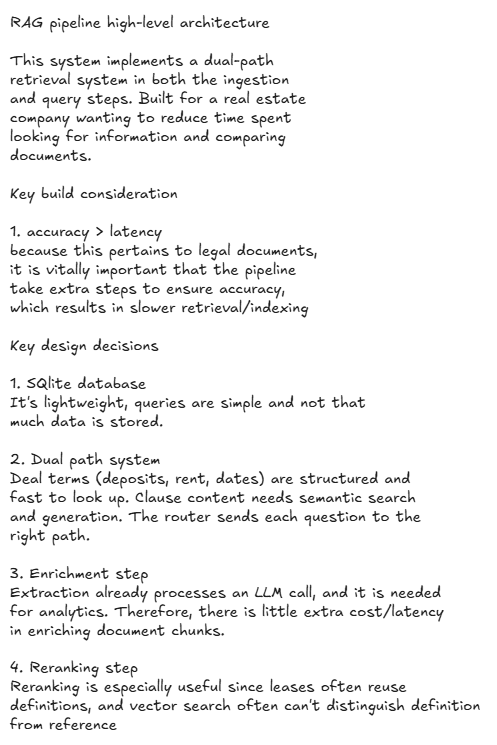
Design notes: dual-path system, accuracy over latency, and why reranking matters for legal leases
DOCUMENT INGESTION
The ingestion pipeline runs when a new lease is added. Documents follow consistent conventions, which allowed context-aware chunking split by Article and Section instead of arbitrary token windows. Because some header patterns produced tiny orphan chunks, I added post-processing to merge those with the next chunk.
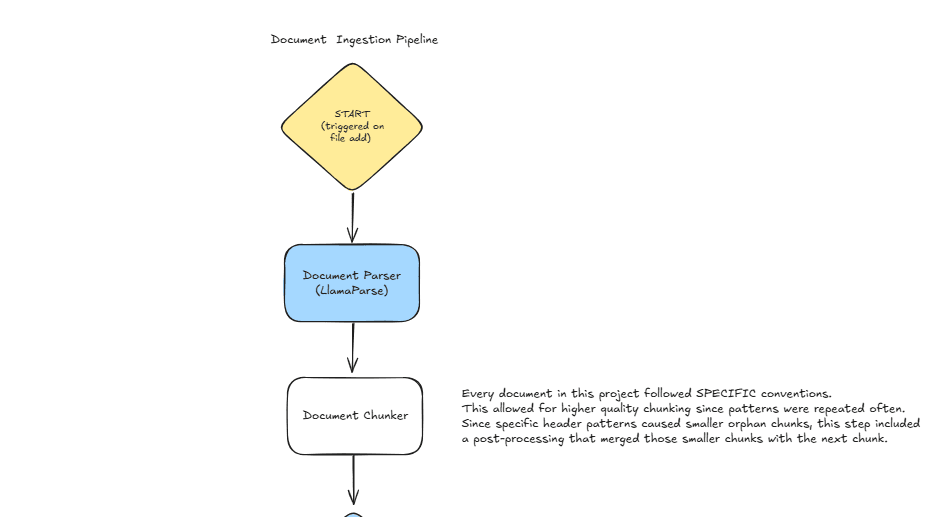
Document ingestion: LlamaParse for PDF→Markdown, then context-aware chunking with custom merge logic
From there, the flow splits into two paths:
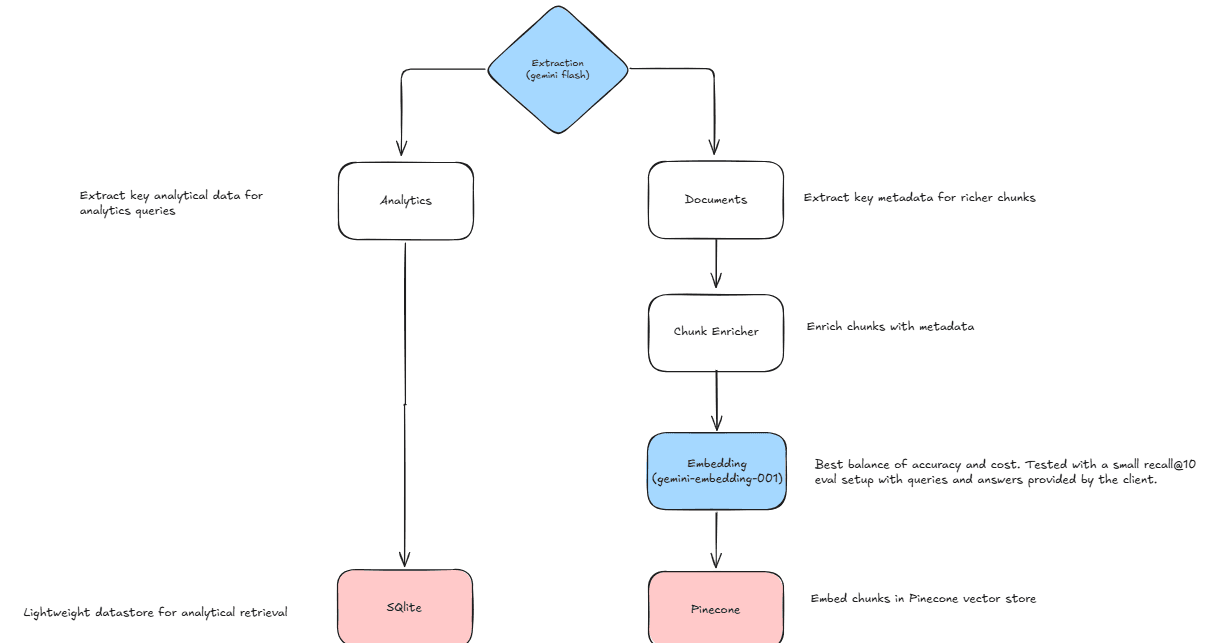
Path A (Documents): Chunk enricher adds metadata, then embeddings (Gemini gemini-embedding-001) are stored in Pinecone. I validated the embedding model with a small recall@10 eval using client-provided Q&A pairs.
Path B (Analytics): Gemini Flash extracts key deal terms (Rent, Dates, Parties, Renewal_Option) into a Pydantic schema via JSON mode, then stored for analytical retrieval.
Dual-path ingestion: structured analytics to SQLite, enriched chunks to Pinecone
QUERY PIPELINE
At query time, a Query Router (Gemini Flash) classifies the user's question and routes it to either the Analytics path (tool calls, SQLite) or the Documents path (vector search, rerank, generation).
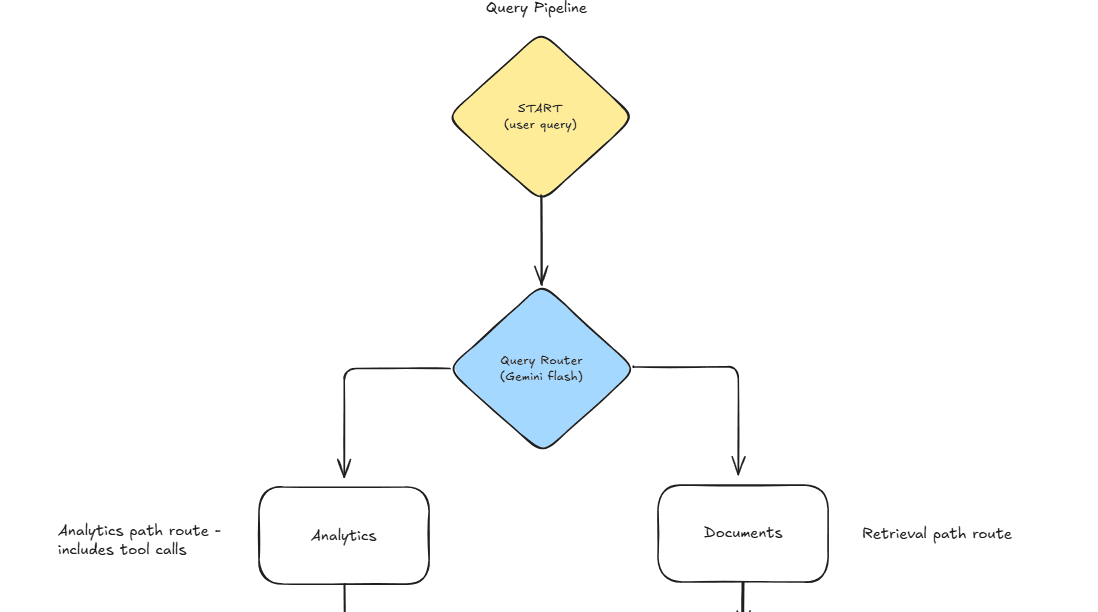
Query Router directs questions to Analytics (tool calls) or Documents (retrieval)
Documents path: Embed query → Pinecone top-k (default 40) → FlashRank rerank to top-n (default 10) → Gemini Flash generates a structured answer with sources and confidence score.
Analytics path: Tool calls execute against SQLite, handlers retrieve data, and the system outputs pre-formatted answers for aggregation-style questions.
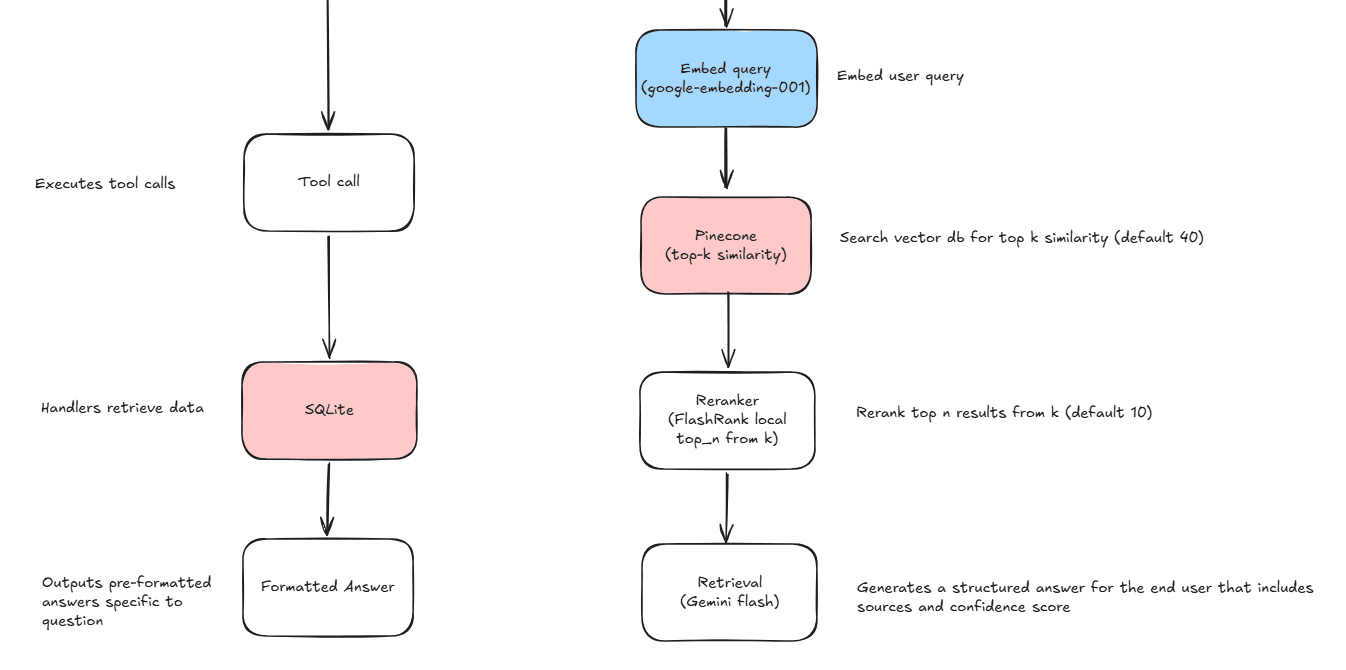
End-to-end query flow: embedding, Pinecone, rerank, generation vs. tool calls and SQLite
THE APPLICATION
The final app exposes all three capabilities through a clean interface: Q&A for natural language questions, Portfolio Analytics for aggregated metrics and lease breakdowns, and Clause Comparison for side-by-side key terms across selected leases. Sensitive client data is redacted in these screenshots.
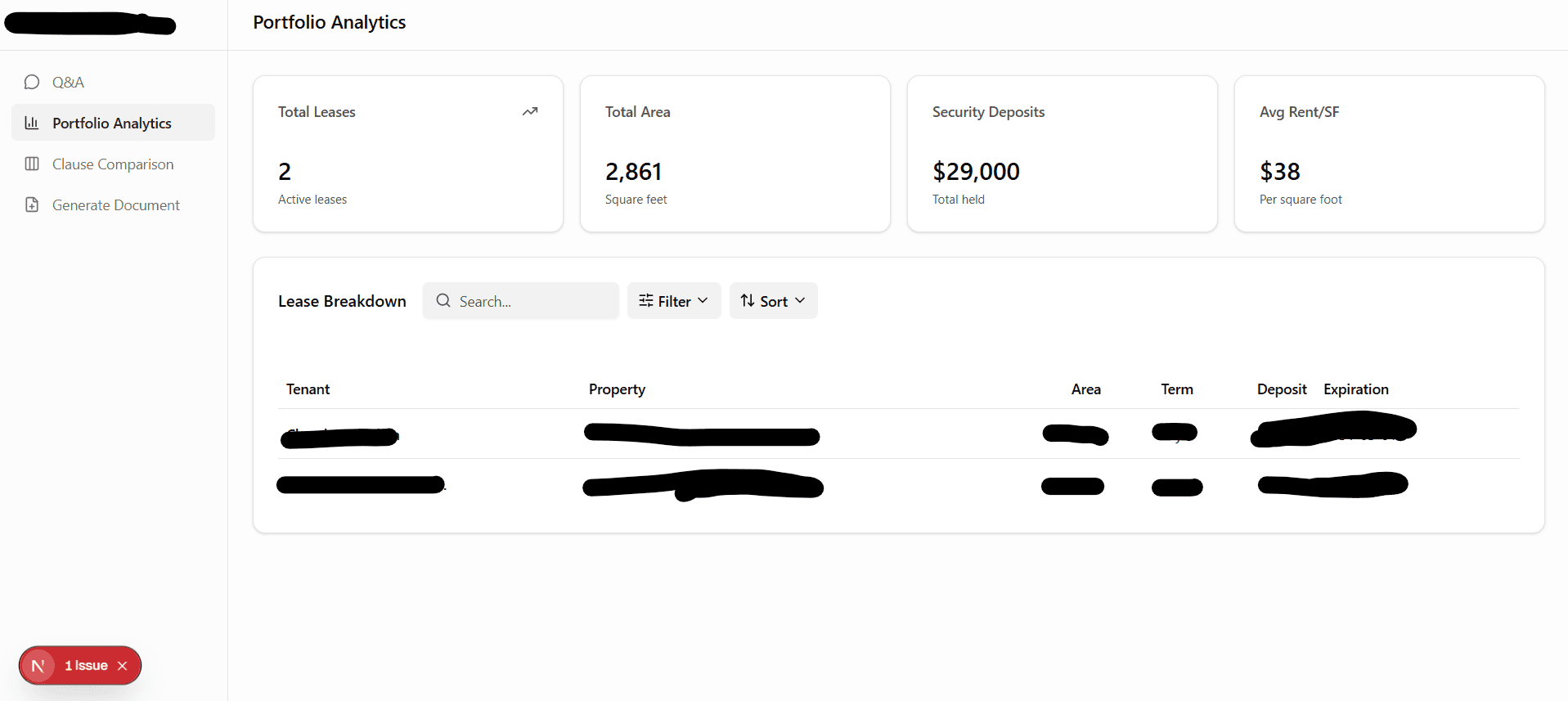
Portfolio Analytics: aggregated metrics (total leases, area, deposits, avg rent/SF) and sortable lease breakdown
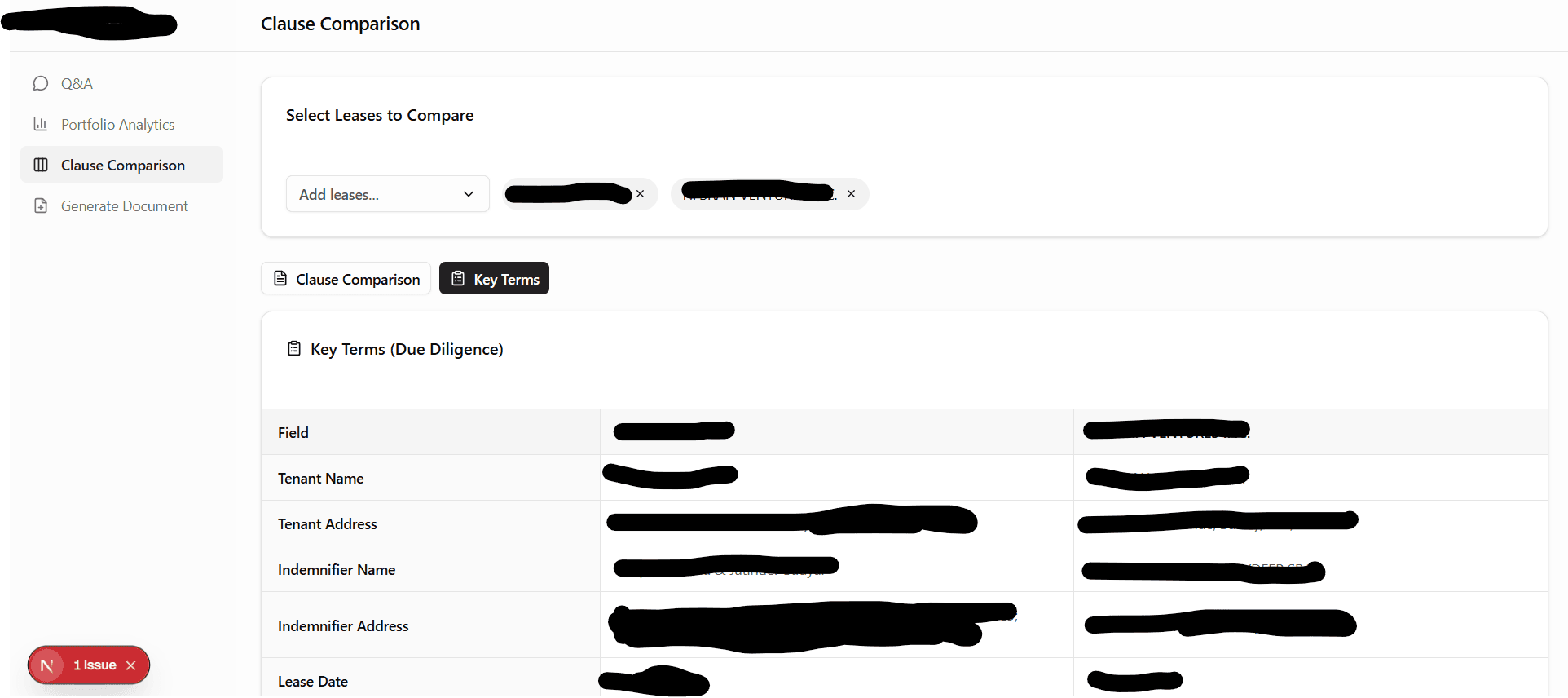
Clause Comparison: select leases and compare key terms side-by-side for due diligence
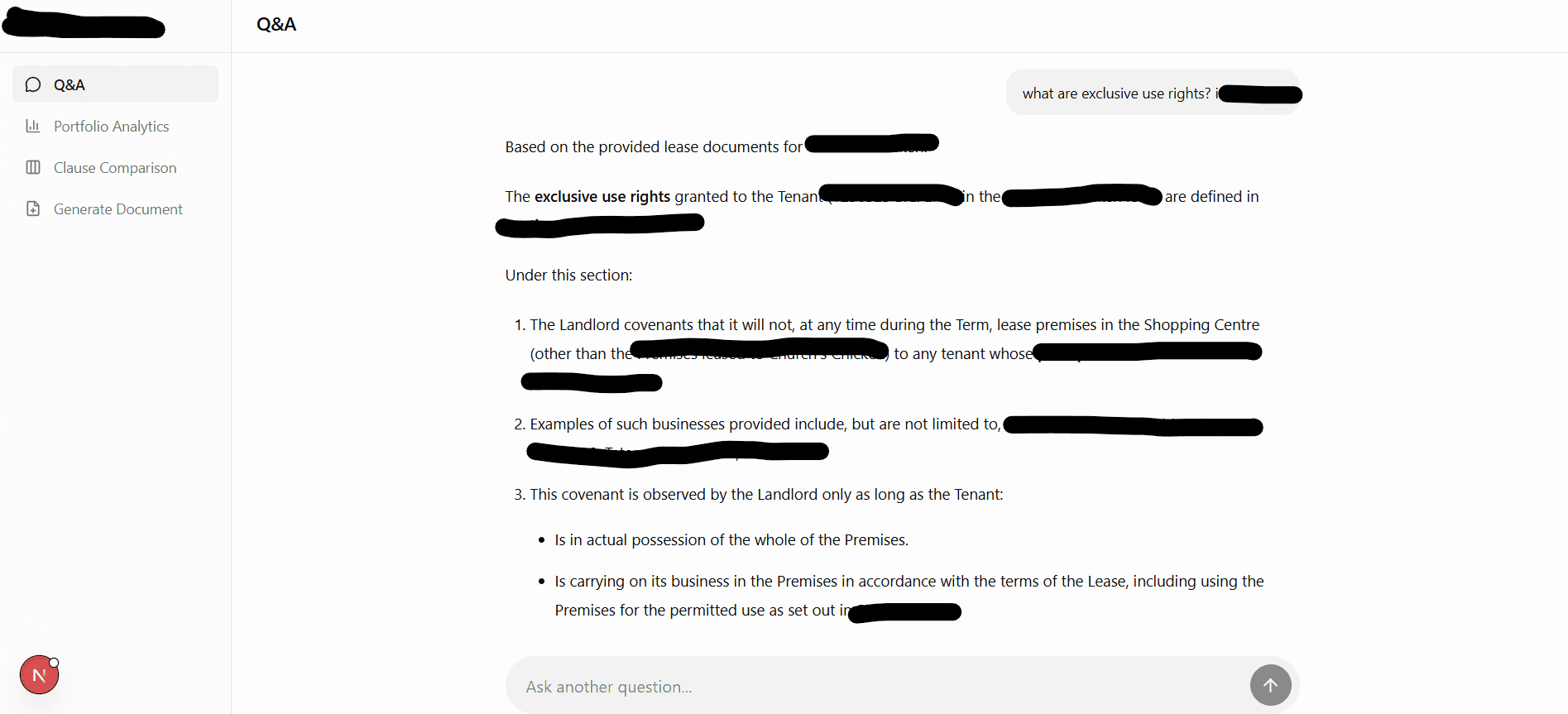
Q&A: Ask the chat bot any lease-specific questions
TECH STACK
| Component | Technology |
| LLM | Google Gemini 2.5 Flash |
| Embeddings | Google google-embedding-001 (768 dims) |
| Vector DB | Pinecone Serverless (cosine, AWS us-east-1) |
| Reranker | FlashRank (ms-marco-TinyBERT-L-2-v2) |
| Parser | LlamaParse (premium mode, Markdown output) |
| Orchestration | LangChain + Google GenAI |
© February 2026